⭐ Four Stars — Tarot, Dark Academia and a Twist I Never Saw Coming
The Cloisters had been quietly gathering dust on my TBR for almost two years, waiting its turn like a slightly mysterious guest at the edge of a party. When my Wheel of Books finally landed on it, I gave a little sigh, made a cup of tea, and decided it was time to see if this moody, tarot-tinged mystery was worth all the patient waiting.
And you know what? It turned out to be a lovely surprise.
This one is a gentle, atmospheric slow burn, full of obsessive academics, medieval symbolism, tangled friendships, and that slightly unsettling feeling that maybe our futures are already mapped out for us. The story takes its time, inviting you into the secretive world of The Cloisters. But as the cracks start to show and the manipulation slips in, you realise things aren’t nearly as harmless as they first seemed. And then the ending comes along and quietly turns everything you thought you knew on its head.
Four stars from me for a dark academia novel that managed to stay intriguing without a hint of romance or spice. If you know me, you’ll know that’s saying something.
📚 Book Details
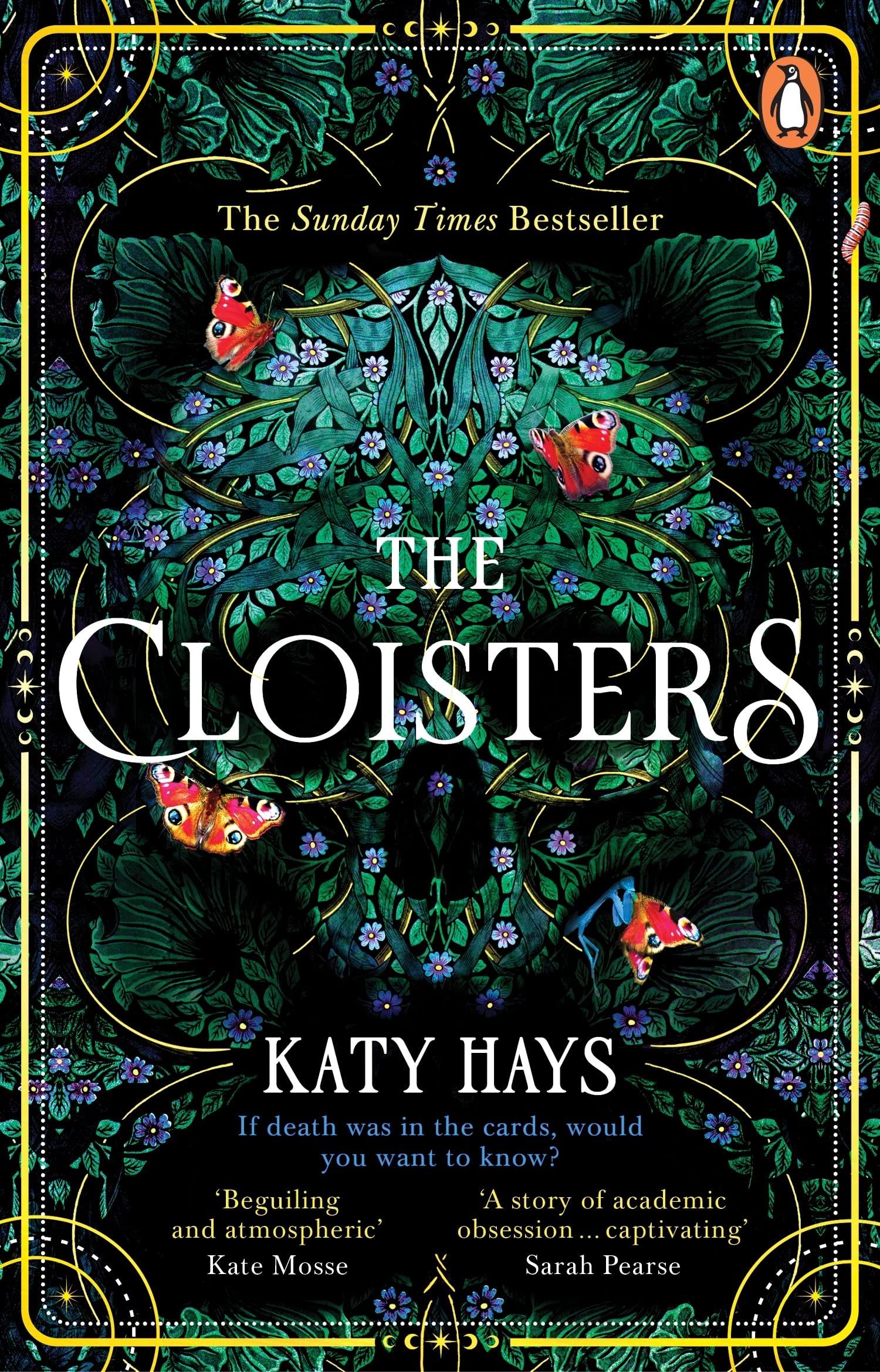
Title: The Cloisters
Author: Katy Hays
Series: Standalone
Format Read: Paperback and Audiobook
Genre: Dark Academia / Mystery / Literary Suspense
Publication Date: November 1, 2022
My Rating: ⭐⭐⭐⭐
Spice Rating: 🫑
Read Type: First Read
Content Note: This story contains death, murder, grief, alcohol and drug use, manipulation, toxic friendships, emotional isolation and discussions surrounding fate, death and poisonous plants.
→ View the full content-warning list here.
Please protect your mental health and check the complete content warnings before reading.
I purchased this book myself. All opinions—and my sudden curiosity about tarot—are entirely my own.
✨ At a Glance
Tropes: Academic Rivalry • Outsider Trying to Belong • Obsessive Research • Toxic Friendship • Slow-Burn Psychological Tension
Vibes: Dark Academia • Gothic Museum Energy • Candlelit Tarot Readings • Intellectual Seduction • Fate Versus Free Will
Mystery: Quiet, character-driven and increasingly unsettling
Romance: Very much in the background
Spice: None
Favourite Character to Analyse: Rachel
Biggest Surprise: That final twist
Would I Reread It? Yes—knowing the ending would make the earlier details fascinating
Most Accurate Reaction: Rachel, what exactly is your angle?
Unexpected Side Effect: I now want to know what tarot cards actually mean
💭 The Quick Take
Picture this: tarot cards scattered across a worn table, the hush of old stone cloisters, and a group of academics who are just a little too invested in their secrets. There are gardens that look lovely in the sunlight but seem to whisper their own mysteries after dark. And just when you think you’ve got it all figured out, the story slips in a twist that completely caught me off guard.
Ann Stilwell steps into New York with dreams of a sparkling summer at The Met, only to find herself tucked away in The Cloisters instead—a quiet, almost secret corner of the city where medieval and Renaissance art feels like it’s holding its breath. It’s here that she falls in with a group of researchers who are fascinated by divination, and who can’t help but wonder if tarot cards might just hold the key to glimpsing what’s ahead.
What starts as simple curiosity soon turns into something much more tangled. Ambition and rivalry creep in, and before long, the line between honest research and something darker gets a little too blurry for comfort.
If you’re looking for a story that races from one twist to the next, this isn’t quite that. Instead, it’s the kind of dark academia mystery that takes its time, letting the atmosphere settle in and the tension build quietly between characters who always seem to be hiding something. It’s the sort of book that feels calm on the surface, but you can sense the storm brewing underneath.
🔮 Story Snapshot — Spoiler Free
Ann Stilwell steps into New York with that hopeful, slightly shaky feeling you get when you’re trying to outrun old heartaches and start fresh. She’s set her sights on a summer at The Met, ready to collect stories and maybe a little confidence, too. But life, as it tends to do, has other plans. Instead of the bustling halls she imagined, Ann finds herself swept off to The Cloisters, where everything feels a little quieter and a little more mysterious.
The Cloisters is the kind of place that feels tucked away from the world, all stone arches and secret gardens, where the city’s noise fades into a gentle hush. The people inside are just as intriguing as the building itself. There’s Patrick, who has a way of making tarot cards sound like ancient treasures. Rachel, with her easy charm and clever mind, seems to offer Ann the sort of friendship she’s always longed for—one that feels like an open door to a brighter, more exciting life. And then there’s Leo, tending to the gardens and quietly watching everything unfold, as if he’s in on secrets the rest of them haven’t quite caught onto yet.
As Ann dives into the mystery of a rare fifteenth-century tarot deck, the lines between fate and coincidence start to blur in the most deliciously unsettling way. Inside The Cloisters, knowledge is its own kind of currency, and everyone seems to be playing their own quiet game. The deeper Ann goes, the more she has to wonder: are the cards really whispering secrets about the future, or is someone behind the scenes, gently nudging the story along? Either way, it’s the sort of puzzle that pulls you in and refuses to let go.
📚 My Reading Experience
🎡 The Wheel of Books Finally Made Me Read It
This book has been quietly waiting on my TBR for almost two years now. Not because I disliked it, or even meant to avoid it. It just sat there, collecting a gentle layer of imaginary dust while I kept reaching for romances, magical worlds, and those delightfully questionable fictional men I can never quite resist.
But then the Wheel of Books spun its mysterious magic and landed on The Cloisters. So, with a little sigh and a curious heart, I decided it was finally time.
I’ll admit, I wasn’t sure how I’d feel about it at first. Dark academia always has a certain pull for me, and the tarot twist sounded intriguing, but I knew this wasn’t going to be one of those stories filled with romance or the kind of drama I usually gravitate towards. Still, I found myself drawn in, page after page. For me, that’s saying something. Turns out, it didn’t need any romance to keep me hooked.
There’s a different kind of tension here—the academic mystery, the heavy, almost claustrophobic atmosphere, and the way the characters start to look at each other with suspicion. I found myself wanting to peek behind every closed door, wondering if Ann was really onto something magical or just getting tangled up in someone else’s obsession. This wasn’t the sort of book that grabs you by the collar right away. Instead, it quietly crept up on me, and before I knew it, I was just as caught up in The Cloisters as everyone else inside those pages.
🎭 Tarot + Dark Academia Was an Unexpected Win
Tarot and dark academia aren’t two things I usually see together, but somehow, they just clicked here. I was honestly surprised by how all the talk of medieval symbols, Renaissance ideas, and tarot history never felt stuffy or dull. Instead, it made the whole world of the story feel richer and pulled me in even more.
Imagine hushed libraries, secret archives, old paintings, and tarot cards flickering in candlelight. There are poisonous plants tucked away in gorgeous gardens, and researchers so wrapped up in their work that the outside world starts to fade. The whole place feels a bit like it’s floating just outside of New York, with stone hallways and carefully tended gardens that make you wonder if time works differently here. It’s the perfect backdrop for a story about people trying to peek into the future—or maybe even shape it.
One thing I really loved: tarot isn’t just there to look pretty. The cards are woven right into the big questions the book is asking—about fate, luck, and whether we’re really steering our own stories or just following a path that’s already been mapped out. It’s the kind of thing that makes you pause and wonder what you’d do in their shoes.
If someone could show you how your life ends, would you genuinely want to know?
By the end, I found myself getting a little curious about tarot—not in a rush-out-and-buy-a-crystal-ball way, but more like, hang on, what do these cards really mean? That’s always a sign a book has done its job for me: it leaves you with something to wonder about, something that sticks around even after you’ve turned the last page.
🌿 Ann’s Growth—and Slow Unravelling
Ann steps into the story as this quietly determined soul from a small town, hoping she can hold her own among all these brilliant minds. She brings her grief and uncertainty with her to New York, along with this huge, hopeful urge to start over. The Cloisters feels like a doorway into a world that’s shinier and more grown-up than anything she’s known, but it’s also a place that gently (and sometimes not-so-gently) asks her who she really is, and who she wants to be.
One of the loveliest things for me was seeing Ann slowly find her feet. She starts to trust what she knows, lets her voice get a little stronger, and even lets herself believe she might actually have something worth saying. But it’s not a straight line. Her growth is messy and tangled up with other people’s motives. She’s learning and changing, but she’s also being pulled in directions she doesn’t always see coming. That push and pull is what makes her journey so fascinating to watch.
Ann’s longing to fit in is so strong that sometimes she doesn’t stop to wonder why certain doors are opening for her. She’s clever, but she’s also a little bit starved for approval—especially from the people she looks up to most. It gets harder and harder to tell where her choices end and other people’s expectations begin.
Is Ann really growing into herself, or is she just turning into the person someone else wants her to be? That little knot of uncertainty kept me turning the pages, even when the story itself took its time.
🚩 Rachel. Just…Rachel.
Trying to figure Rachel out felt a bit like trying to solve a puzzle with half the pieces missing. Every time she appeared, I found myself tilting my head, wondering: is she here to help, to compete, to befriend, or to quietly upend everything? Maybe she’s all of those things at once. I was never quite sure, and honestly, that was half the fun.
There’s this effortless, almost magnetic confidence about Rachel—the kind that makes you want to impress her, even as your inner alarm bells are quietly losing their minds. She just gets how things work at The Cloisters. She glides through the academic maze, knows exactly which strings to pull, and somehow manages to make Ann feel like she’s been handpicked for something extraordinary.
Watching their friendship unfold felt a bit like watching someone step onto a frozen pond—beautiful, but you’re never quite sure if it’s safe. Rachel gives Ann this intoxicating mix of knowledge, confidence, and that elusive sense of belonging, but there’s always a little tilt to the scales. Ann can’t help but look up to her, and before long, Rachel’s opinions start to seep into Ann’s own. I kept telling myself not to trust her, but honestly, I was hooked.
Rachel is the perfect example of how being drawn to someone’s mind can be every bit as dizzying as any crush. Ann isn’t just fascinated by Rachel herself—she’s pulled toward everything Rachel seems to promise: confidence, privilege, a sense of belonging, and a golden ticket into a world Ann has always dreamed of joining.
So many red flags, and yet I absolutely loved every deliciously tense moment.
🏛️ The Cloisters Is Almost a Character Itself
The Cloisters isn’t just a backdrop here—it’s the kind of place that quietly seeps into everything, shaping not just what happens but how everyone feels. It’s almost like there’s an extra character in the room, one that never says a word but somehow manages to steer the story all the same.
Even though The Cloisters sits right in the middle of busy New York, it somehow manages to feel worlds away. The moment Ann slips through those stone corridors or wanders into the tucked-away gardens, the city’s noise just fades into the background. It’s like stepping into a little pocket of time that doesn’t quite belong to the rest of the world. That sense of being cut off from everything else is exactly what lets all those obsessions and fixations grow wild—there’s nothing from the outside to keep them in check.
The researchers here lose themselves in old books, strange artefacts, and ideas that feel like they belong to another century. Inside these walls, their work feels huge and urgent, even though it’s almost like the rest of the world has been put on pause. That distance from everyday life makes everything inside The Cloisters feel more intense, more meaningful. It’s easy to see why the people here start to act a little differently—their priorities shift, and suddenly the usual rules don’t seem to matter as much.
Within The Cloisters, something as simple as hunting for a lost tarot deck can suddenly matter more than friendships, trust, or even your own safety. The people here get swept up in the chase for knowledge or rare treasures, letting everything else fall away. But for all its beauty, The Cloisters hides a little shiver of menace just beneath the calm. At first, it’s easy to miss, but before long, you can’t help but feel it.
Take the museum’s gardens—they’re gorgeous, but tucked among the flowers are plants that could do real harm. It’s a quiet reminder that even the loveliest places can hide something dangerous. The artefacts scattered throughout The Cloisters aren’t just old objects, either. They come with their own stories and risks, and sometimes it feels like they’re just waiting to stir up a little trouble.
Here, even curiosity can turn into something a little sharp-edged. Knowledge is its own kind of power, and wanting it badly enough can make people do things you wouldn’t expect. There’s no need for ghosts or jump scares—the real tension comes from the people themselves, and just how far they’ll go to get what they want. In a place where the usual lines get blurry, ambition and desire can run wild.
🌱 Leo—the Peripheral Man Who Isn’t
Leo is the museum gardener who always seems to be just out of reach—moody, a little aloof, and somehow both present and not. At first, he gives off that classic ‘just here for the plants’ vibe, as if he’s only passing through the story. But of course, he’s quietly woven into everything. You’ll find him on the edges, hands deep in the soil, watching the researchers with a kind of gentle curiosity. He never quite fits into their world of academic drama, and honestly, I think he prefers it that way. While everyone else is busy chasing secrets in dusty manuscripts, Leo is grounded in the here and now—the scent of earth, the slow patience of growing things. He brings a different sort of wisdom, the kind that comes from noticing what others miss and letting the world unfold at its own pace.
He’s a bit of a puzzle, but not in the same way as Rachel. With her, I was forever second-guessing motives and wondering whose side she was really on. Leo’s mystery is quieter. I found myself less curious about what he wanted, and more about what he already knew—what secrets he might be quietly tucking away while everyone else was busy talking over each other.
At first, Leo might seem like he’s just part of the background—one of those characters you almost miss if you’re not paying attention. But as the story starts to unravel, his quiet presence suddenly feels essential. He’s got that timeless mysterious gardener energy, the kind that makes you wonder what he’s seen while everyone else was looking the other way. It’s a subtle magic, and it works. Leo lingers in your mind long after you’ve turned the page.
🎓 Ambition, Class and the Need to Belong
Beneath all the tarot cards and tangled mysteries, The Cloisters is really a story about power—who gets to slip behind those velvet ropes, whose voice carries weight in a room, and whether being clever is ever enough when money, old-school connections, and the right kind of background are all quietly at play.
Ann steps into this world already feeling like she’s a few paces behind everyone else. She’s put in the work, she knows her stuff, but she doesn’t have that easy confidence—the kind that comes from always assuming the doors will swing open just for you. So when Rachel offers her approval, it lands with a special kind of weight.
The book really gets how fierce that longing to belong can be, especially in places that feel just out of reach. It’s not that Ann isn’t smart enough to see what’s happening—she’s just so clear about what she wants, and someone else is clever enough to notice.
Ann is searching for all the things that make a place feel like it could finally be hers: a little recognition, a shot at something bigger, maybe even a chance to reinvent herself and finally pull up a chair at the table.
There’s something so tempting about the academic world in this book—it looks like knowledge is the real ticket to power. But as Ann edges closer, she starts to see how ambition and rivalry twist themselves around every opportunity, and how the gates aren’t always open, no matter how much you know.
Everyone’s busy studying fate, but at the same time, they’re all quietly trying to decide who actually gets to shape it.
🕯️ Quiet Doesn’t Mean Nothing Is Happening
This is one of those slow-burn books, and I mean that in the coziest way possible. If you’re expecting car chases or a fresh mystery body every few chapters, you might want to adjust your expectations. Here, the tension bubbles up in quiet conversations, in the way people look at each other just a little too long, in friendships that start to feel a bit off. The danger doesn’t shout—it tiptoes in, and you only notice it when you’re already holding your breath.
It’s the little things that set you on edge—a strange discovery here, a conversation that just doesn’t sit right there, someone holding back a little too much, or a friendship that starts to feel more like a tug-of-war. All these tiny signals quietly whisper that something isn’t quite as it seems.
The atmosphere does a lot of the heavy lifting here, keeping things quietly ticking along even when it feels like not much is happening on the surface. I actually loved sinking into the mystery, just watching Ann get more and more tangled up in the researchers’ world, like I was right there beside her.
That said, the slow pace is probably why this one landed at four stars for me instead of five. There were a few stretches where I found myself wishing the story would pick up the pace a little—some of the academic details and all that internal mulling over did start to feel a bit long, especially before the darker threads finally started weaving together.
But once those darker pieces started to slot into place, I was so glad I’d stuck with it. Sometimes a little patience really does pay off.
🔥 That Ending, Though…
I have to admit, that final twist caught me off guard in the best possible way. Suddenly, everything I thought I knew about ambition, manipulation, fate, and choice felt like it had been gently shuffled and dealt out again.
The tarot symbolism weaves through the story in a way that feels genuinely earned, not just tacked on for effect. The cards don’t swoop in to solve every mystery; instead, they echo that delicious uncertainty that lingers from start to finish.
It left me wondering: was it fate pulling the strings, or were the characters quietly shaping their own destinies all along? Maybe just believing in fate was enough to blur the lines until it didn’t really matter anymore.
By the end, I found myself rethinking everything about Ann—her growth, her connections, even the motives I thought I had all figured out. It’s the sort of reveal that makes you want to flip back to page one and hunt for all those little breadcrumbs you missed the first time.
All along, the book had been quietly laying out its cards, and I didn’t even notice I was already holding the final hand.
⭐ Why It Earned Four Stars
The Cloisters really caught me off guard in the best way, wrapping me up in this lush, gothic atmosphere that felt almost like wandering through a dream. The tarot elements were woven in so cleverly, I found myself wanting to pull a card just to see what might happen next. The characters moved around each other with this subtle, almost whispered manipulation that kept me guessing. Rachel always had me side-eyeing her, and watching Ann slowly change felt like watching a friend step into a new version of herself. And that museum setting? It gave the whole story a sense of place that felt both mysterious and oddly comforting. I absolutely did not see that final twist coming.
If I’m being honest, it didn’t quite make it to five stars for me. There were a few moments where the story slowed down a little more than I wanted, and I found myself wishing the tension would pick up just a bit sooner. But even then, I couldn’t help but stay curious, always wanting to see what would happen next.
And honestly, for a story with no romance and not a hint of spice, that’s saying something. This is one of those dark academia mysteries that sneaks up on you, quietly sharpening its blade while you’re busy admiring the scenery, and then gives it a twist right at the end. Four stars from me, and a little shiver for good measure.
🔮 Character Corner
Favourite Character to Analyse: Rachel
Most Compelling Character: Ann
Character I Trusted Least: Honestly, almost everyone
Character Who Surprised Me Most: Ann
Favourite Dynamic: Ann and Rachel’s magnetic, increasingly unsettling friendship
Biggest Mystery: Whether anyone inside The Cloisters is being completely honest
Most Accurate Rachel Description: A walking red flag wrapped in intellectual superiority
Most Accurate Ann Description: An outsider learning to claim her voice while quietly losing control of the story
🌿 Ann Stilwell — The Outsider Desperate to Belong
Ann’s vulnerability isn’t about not being clever enough. It’s more about that ache of loneliness, the weight of grief, and the quiet hope that maybe, just maybe, she’ll finally find her place. She wants The Cloisters to feel like home, somewhere she can shed her old self and be seen for what she knows. That longing is what makes her so easy to root for, even as it leaves her a little exposed.
Watching Ann change is a bit like watching someone step into sunlight for the first time—she grows bolder, but her choices get messier, too. The more she soaks up from the people around her, the harder it is to tell if she’s really becoming herself or just slipping into someone else’s idea of who she should be. She keeps a lot tucked away, and by the last page, I found myself wondering if I’d ever really known her at all.
🚩 Rachel — Approval Has Never Felt So Dangerous
Rachel is the kind of person who lights up a room and leaves you a little off-balance at the same time. She knows just how to make Ann feel special, and she’s well aware of how much power that gives her. Their friendship is a tangle of admiration, rivalry, affection, and a hint of something sharper—all swirling together, sometimes in the same breath. Rachel pulls Ann deeper into The Cloisters, turning the academic world into something glittering and just out of reach. I never quite trusted her, but I couldn’t look away. If red flags could quote poetry, they’d probably look a lot like Rachel.
🖤 Relationships, Tension & Spice
🎭 The Relationships
This isn’t a romance-forward story. The central relationship is the increasingly intense friendship between Ann and Rachel. Their connection carries the seductive energy usually reserved for romance, but what draws Ann in is as much intellectual as it is personal—she wants Rachel’s knowledge, her confidence, her approval, and her place within the museum. The dynamic becomes compelling because admiration and manipulation are so closely tangled together.
There are hints of attraction and other personal connections around the edges of the story, but they never become the main focus. The strongest tension comes from toxic friendship, academic rivalry, and the constant question of who is using whom.
🫑 The Spice
There’s no spice here. While there’s some subtle sexual tension and discussion of desire, this isn’t an explicit book and romance remains firmly in the background. The intensity comes from psychological manipulation, intellectual obsession, and mistrust rather than physical intimacy.
Did I still stay intrigued?
Surprisingly, yes. The character development kept me intrigued throughout.
🎧 Audiobook Notes
Narrator: Emily Tremaine
Emily Tremaine felt like the perfect match for Ann. There’s a quiet vulnerability in her voice that made Ann’s uncertainty and curiosity feel so real, almost as if you’re right there with her, peeking around corners and second-guessing every thought. I loved how Emily never pushed too hard—her performance stayed gentle and observant, letting Ann’s slow unravelling sneak up on you in the best way. You can sense every flicker of self-doubt, every little surge of confidence, and those moments when curiosity starts to tiptoe into obsession.
What I really appreciated was how Emily never gave the game away. She kept the mystery simmering quietly, never tipping her hand or making the twists too obvious. The whole thing felt so intimate and a little bit close, like Ann was whispering secrets from a shadowy corner of The Cloisters. It’s the kind of narration that makes you want to lean in and listen just a little bit closer.
I found myself switching between the paperback and the audiobook, but honestly, it was Emily’s narration that pulled me through the slower bits and made the whole story feel more alive. Some books just work better in your ears, and this was definitely one of them. If you’re looking for something to listen to that feels quietly immersive, this is such a good pick.
💬 A Line I Had to Save
“What if our whole life—how we live and die—has already been decided for us? Would you want to know, if a roll of the dice or a deal of the cards could tell you the outcome? Can life be that thin, that disturbing?”
✨ The Bookish Extras
📸 Meet Ann Stilwell
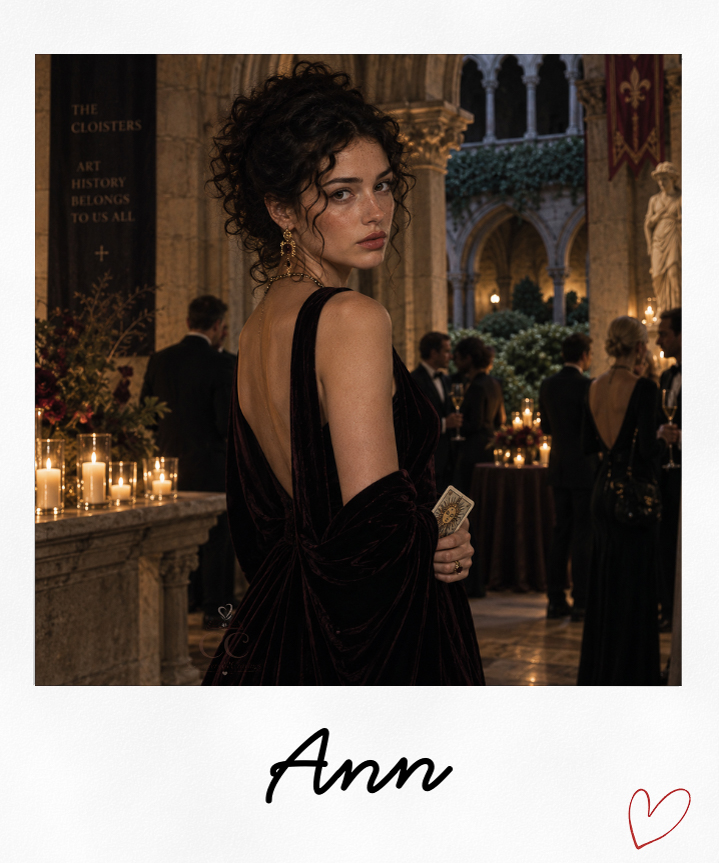
My imagined version of Ann Stilwell, created using AI from her character description in the book.
🎵 The Soundtrack
Gregorian chants, gothic museum corridors, candlelit tarot readings and the creeping realisation that someone has been arranging the cards all along.
📌 Enter the World of The Cloisters
Medieval art, Renaissance tarot decks, stone archways, poisonous gardens, dusty archives and academics who would absolutely sacrifice a healthy work-life balance for one career-changing discovery.
💌 You’ll Love This If…
You may enjoy The Cloisters if you:
- Love dark academia
- Enjoy atmospheric mysteries
- Prefer psychological tension over action
- Find tarot and divination fascinating
- Like gothic museum settings
- Enjoy morally grey intellectual characters
- Love toxic and complicated female friendships
- Appreciate unreliable or withholding narrators
- Enjoy stories about fate versus free will
- Like scholarly research woven into fiction
- Don’t need romance to drive the plot
- Want tension without explicit spice
- Enjoy slow, character-driven mysteries
- Like endings that reframe the entire story
- Have ever looked at a suspicious academic and thought, “I need to know your secrets”
You May Want to Skip It If…
This may not be for you if:
- You prefer fast-paced thrillers
- You need romance to be central
- You want open-door spice
- Lengthy academic discussions lose your attention
- You dislike morally complicated protagonists
- Toxic friendships are frustrating rather than fascinating
- You prefer mysteries with constant action
- You need every supernatural question to receive a definite answer
- You dislike slow-building tension
- You’re hoping for cosy museum vibes without murder or manipulation
My verdict: Pick it up when you’re in the mood for something quiet, gothic and psychologically unsettling—not when you want a fast, romance-heavy thriller.
⭐ The Final Chapter
Would I Recommend It? Yes—to dark academia and atmospheric mystery readers
Would I Reread It? Yes, to spot everything I missed
Did the Ending Satisfy Me? It caught me completely off guard
Favourite Character to Analyse: Rachel
Most Compelling Character: Ann
Favourite Element: Tarot woven into the questions of fate and choice
Biggest Surprise: How well it held my attention without romance or spice
Biggest Strength: The gothic museum atmosphere
Smallest Weakness: The pacing occasionally became too slow
Best Format: Audiobook alongside the paperback
Most Accurate Summary: Quiet dark academia that twists the knife at the end
Book Hangover Level: Still side-eyeing every tarot card
Shelf Keeper? Yes
Overall Rating: ⭐⭐⭐⭐
🖤 Final Thoughts + Come Chat
The Cloisters quietly crept up on me in the best way. It’s one of those books that feels soft and shadowy at first, all gentle moods and subtle hints, and then suddenly you realise it’s been holding a secret all along.
This one lingered on my TBR for almost two years, quietly waiting its turn until the Wheel of Books nudged it into my hands. I’m honestly grateful for the push. The mix of tarot and dark academia felt like stepping into a world that was just a little off-kilter from my usual reads. There’s something about the purposeful research, the heavy hush of the museum, and all those tangled questions about fate that made the mystery feel richer than just a simple whodunit.
Ann’s journey really pulled me in, mostly because her growth never felt neat or easy. She’s finding her confidence and learning to trust what she knows, but she’s also lonely and so hungry to belong that it makes her heartbreakingly easy to read. I found myself rooting for her and worrying about her in equal measure.
And then there’s Rachel, who is basically a walking bundle of red flags wrapped up in charm and academic brilliance. I spent the whole book trying to decide if she was a friend, a rival, a mentor, or just a very stylish warning sign. Honestly, I loved not knowing.
There were a few moments where the story slowed down more than I’d hoped, which kept it from being a full five-star read for me. But honestly, the atmosphere, the tangled relationships, and that final reveal made every slow page worth it. The ending genuinely surprised me and had me rethinking everything I thought I knew about these characters. I’m still not sure where fate stopped and choice began, and I kind of love that.
So, four stars from me for a simmering, atmospheric mystery full of tarot cards, ambition, manipulation, and academics who could probably use a few more wholesome hobbies.
Have you read The Cloisters yet? Did you spot that ending coming, or did it turn everything upside down for you too? And if tarot keeps popping up in dark academia, are we just going to call it a new subgenre and be done with it? Come chat with me in the comments, but let’s keep the big twist under wraps for anyone who hasn’t had their fate sealed by The Cloisters yet! 🔮






Leave a Reply