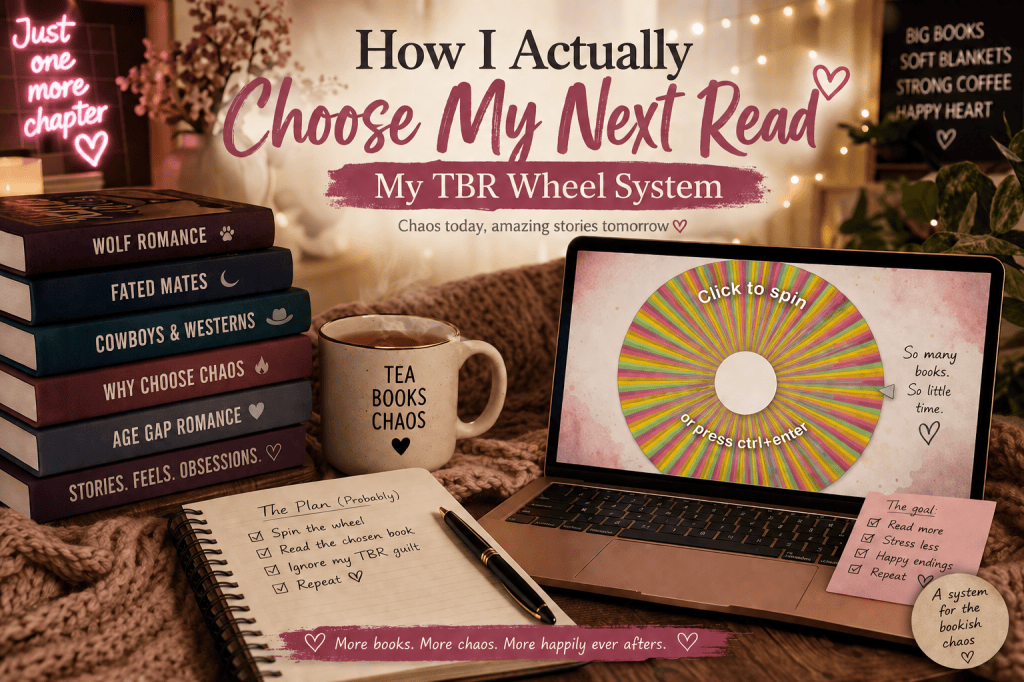
My wonderfully chaotic TBR wheel system for choosing between physical books, ebooks, audiobooks and far too many unfinished series.
If you’ve ever looked at your TBR and thought:
“Wow. I really need to get my life together.”
Welcome. You are safe here.
Because I don’t have a neat little pile of ten unread books waiting patiently beside my bed.
I have…a lifestyle.
Between physical books, ebooks and audiobooks, my unread collection is sitting somewhere north of 800 books.
Yes. Eight. Hundred.
No, I will not be taking questions at this time.
Some readers lovingly curate their TBR. Some colour-code it, organise it by genre and maintain carefully planned monthly reading lists.
And then there’s me—hoarding stories like a dragon with emotional baggage.
I’d love to tell you I’m a calm, intuitive mood reader who always knows exactly what she wants to read next.
But sometimes my brain goes:
- Vibes? Unknown.
- Mood? Offline.
- Decision-making skills? Absolutely not.
That’s when I bring out the wheel.
😵 Why Having More Choice Makes Choosing Harder
You’d think owning hundreds of unread books would mean I always have something to read.
Technically, I do.
In reality, having so many choices can make picking just one feel almost impossible.
I’ll look through my physical shelves, scroll through my ebooks and then check my audiobook library. Before I know it, I’ve spent forty-five minutes comparing books without actually beginning any of them.
I might want romance—but what kind?
Do I want something dark and dangerous? A comforting cowboy romance? Fantasy with high stakes? A why-choose relationship containing several questionable men? Something light and funny? A book that will emotionally destroy me before putting me back together again?
Apparently, “I want to read a book” is not enough information for my brain to work with.
Then I’ll find myself scrolling through new releases and adding even more books to the TBR instead.
Because naturally, the solution to being overwhelmed by hundreds of unread books is buying another one.
Flawless logic.
🎡 Enter: The TBR Wheel
When my brain refuses to cooperate, I outsource the decision.
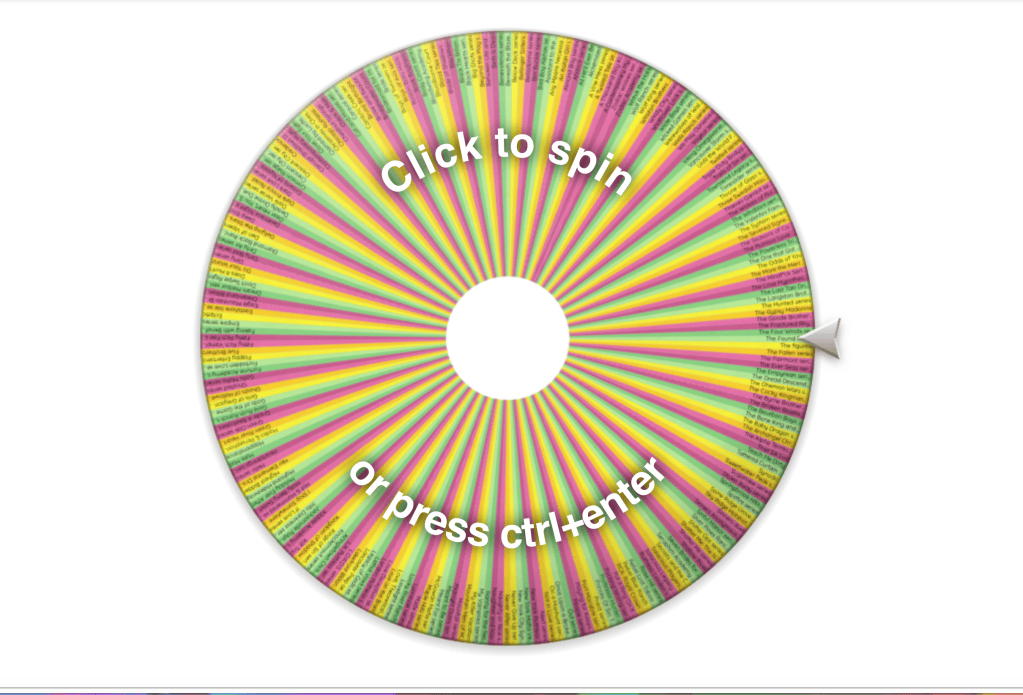
I use Wheel of Names—a website usually reserved for classroom activities, raffles and giveaways—and I’ve turned it into my personal reading overlord.
All my unread books and series are added to the wheel. When I can’t decide what to read, I spin it and let fate choose for me.
Is it dramatic?
Yes.
Is it effective?
Also yes.
There’s something deeply freeing about pressing a button and saying:
“This is no longer my responsibility.”
The wheel breaks the endless cycle of browsing, comparing and second-guessing. Instead of trying to find the perfect next book, I’m given one clear answer.
More importantly, it gets me reading.
🛠️ How My TBR Wheel Is Set Up
My wheel includes books from across my reading life:
- Physical books
- Ebooks
- Audiobooks
- Standalone novels
- Unread series
- Series I’ve already started but haven’t finished
I don’t create separate wheels for every format or genre because I want the full collection to have a chance.
If the wheel chooses a physical book, that’s what I pick up. If it chooses something I own digitally, I read the ebook. If the next title is available as an audiobook, I can listen while I’m travelling, doing housework or getting on with everyday life.
The format doesn’t matter as much as finally giving one of my unread books its moment.
There is, however, one important difference between how I add standalone books and how I add a series.
Because while this system may be chaotic, it is organised chaos.
📏 The Series Rule
I may be chaotic, but I’m not completely unhinged.
If I’ve read Books 1 and 2 of a series and the wheel chooses that series again, I move forward to Book 3.
I don’t restart the entire series every time because I’ve forgotten someone’s cousin’s name or can’t remember exactly why two side characters were arguing in Chapter 14.
That way lies madness.
If I genuinely need a reminder, I can look for a recap, reread my own notes or skim the ending of the previous book. I don’t need to return to Book 1 and trap myself in an endless restart spiral.
This rule helps prevent two things:
- Restarting instead of progressing
- Avoidance disguised as “refreshing my memory”
We move forward in this house.
🤔 Why Don’t I Just Binge the Complete Series?
Ah. The question.
Some readers love disappearing into a series and reading every book consecutively. I completely understand the appeal—especially when each instalment ends on a cliffhanger that makes stopping feel physically impossible.
I’ve done it too.
I inhaled the A Court of Thorns and Roses books one after another like my life depended on it.
Zero restraint. No regrets.
But most of the time, I prefer to sprinkle series books between other reads.
Reading several books set in the same world back-to-back can occasionally make them blur together. I might start forgetting which events happened in which book or feel less excited about characters I genuinely enjoy.
Even a favourite writing style can begin to feel repetitive if I consume too much of it at once.
Taking a break gives the story space to settle. I can return to the characters feeling excited rather than reading the next instalment simply because I’ve decided I must finish everything immediately.
That said, this isn’t a strict ban.
If a series has grabbed me and I desperately want to continue, I will.
The wheel is a reading tool—not a tiny multicoloured dictator.
🎧 What About Audiobooks?
Audiobooks are included because they’re a huge part of how I read.
Sometimes I’ll own a physical or ebook copy but choose to listen to the audiobook instead. It still counts as reading the book, and it still removes another title from my unread collection.
Audiobooks also make certain books much easier to fit into everyday life. I can listen while doing jobs that don’t require my full attention, which is especially useful when sitting down with a physical book isn’t realistic.
If a title is no longer available as an audiobook, I can either read another edition I own or decide whether I’m willing to buy it in a different format.
I don’t want the wheel to become another source of pressure. The aim is to use the books already available to me—not make every spin unnecessarily expensive.
🎭 Does My Reading Mood Get a Say?
Yes. Absolutely.
I’m still a mood reader, even when the wheel is doing the choosing.
The wheel helps when I have no strong preference. It doesn’t mean I have to force myself through a dark, emotionally heavy romance when my brain is begging for something funny and comforting.
Before I spin, I can remove anything that clearly doesn’t suit my current situation.
For example, I might temporarily exclude:
- Extremely long books when I want something quick
- Dark or emotionally intense stories when I need comfort
- Physical books when I specifically need an audiobook
- Seasonal books that feel completely wrong at that time
- A later series entry when I need to refresh my memory first
- Books I’m simply no longer interested in reading
That last one is important.
The TBR is allowed to change. I’m not legally required to read every book I once thought sounded interesting.
If the wheel lands on a title and my immediate reaction is genuine dread, that tells me something useful. Maybe I’m not in the mood today—or perhaps the book no longer belongs on my TBR at all.
🔄 Do I Ever Spin Again?
The official rule is that I accept the first result.
No bargaining. No repeatedly spinning until the wheel produces the book I secretly wanted all along.
Because if I already know what I want to read, I don’t need the wheel.
However, I do allow a few sensible exceptions:
- The book isn’t currently available to me.
- It’s part of a series and I’m missing an earlier instalment.
- The content doesn’t suit my current emotional state.
- I need a different format for practical reasons.
- I’ve realised I no longer want to read it.
- It’s a seasonal book I’d rather save for the appropriate time.
A reroll should solve a genuine problem—not become a way of rejecting every book that isn’t instantly perfect.
If I keep wanting to respin, that usually means one of two things: I already have another book in mind, or the wheel needs updating.
✨ The Unexpected Reaction Test
One of the best things about the wheel is that my immediate reaction can reveal what I truly want.
If the wheel lands on a book and I feel excited, brilliant. Decision made.
If it lands on something and I immediately think, “Oh…I was hoping it would choose the cowboy romance,” then I’ve also got my answer.
Sometimes we don’t know what we want until something else is chosen for us.
The wheel doesn’t always have to dictate the final decision. Occasionally, its job is simply to expose the preference hiding underneath all the indecision.
That still counts as working.
🧹 How I Keep the Wheel Manageable
A system like this only remains helpful if it roughly reflects the books I actually own and want to read.
I don’t update it every time I finish a chapter or purchase one ebook. That would turn a fun reading tool into a full administrative position, and I already have enough to do.
Instead, I give it an occasional tidy-up.
During an update, I:
- Remove standalone books I’ve finished.
- Remove series I’ve completed.
- Add recent purchases and downloads.
- Check that unfinished series are still included.
- Remove books I’m no longer interested in.
- Correct duplicates or titles added under different names.
- Make sure I still own or can access everything listed.
This doesn’t need to happen weekly. An update every few months—or whenever the wheel starts feeling noticeably outdated—is enough.
The system should support my reading life, not become another task demanding constant attention.
🗂️ A Simple Version You Can Try
You absolutely do not need 800 unread books to use this method.
A wheel works just as well with ten titles.
If you want to make your own, start by choosing a manageable group, such as:
- Books already on your bedside table
- Your oldest unread books
- Kindle books you’ve forgotten you own
- Unfinished series
- Books bought during the past year
- Recommendations from friends
- Five different genres to match different moods
Add each standalone title individually and add series by their overall name. Decide in advance whether you’ll accept the first result and which situations allow a respin.
Then press the button.
Congratulations. You’ve officially outsourced your reading decisions to a colourful circle on the internet.
🌱 Why This System Works for Me Long-Term
The wheel works because it isn’t a strict monthly TBR.
I’ve attempted structured reading plans before, and they can look lovely when I create them. There might be a carefully balanced mixture of genres, a sensible number of books and perhaps even a seasonal theme.
Then the first day arrives, my mood changes and the entire plan collapses.
A permanent wheel is more flexible. I don’t need to predict what I’ll want to read for the next month. I only need it when I’m ready to choose one book.
It also helps older purchases compete with shiny new releases. Without some kind of system, it’s very easy for a book I bought three years ago to disappear behind whatever everyone is currently talking about.
The wheel gives those forgotten books another chance.
It helps me:
- Reduce decision fatigue
- Read books I already own
- Return to unfinished series
- Rediscover forgotten purchases
- Use different reading formats
- Keep choosing fun rather than obligation
I’m never going to “complete” my TBR—and honestly, I’m not sure I want to.
A completely empty unread shelf would feel slightly alarming.
But I can make sure the books I’ve collected aren’t permanently forgotten.
🚫 What the Wheel Doesn’t Do
The wheel doesn’t guarantee that I’ll love every book it chooses.
It doesn’t prevent reading slumps, magically create more reading time or stop me from buying new books when I already own enough to stock a small library.
Sadly.
It also can’t always account for:
- New releases I’m desperate to read immediately
- Library loans with return dates
- Review copies with deadlines
- Book-club selections
- Sudden and very specific reading moods
- A sequel released years after I added the series
And that’s fine.
No reading system needs to control every book I pick up. Sometimes I’ll follow the wheel. Sometimes I’ll know exactly what I want. Sometimes a new release will jump straight to the front because patience has never been one of my strongest qualities.
The system works because it’s flexible enough to survive real life.
💤 What If the Chosen Book Isn’t Working?
Being selected by the wheel doesn’t give a book immunity from being put down.
I’ll give it a fair chance, but if I’m not enjoying it, I’m allowed to stop.
My TBR is far too large to spend my limited reading time forcing myself through something purely because a spinning wheel chose it.
Depending on the problem, I might:
- Pause it and return later
- Switch from physical to audio
- Try a different book in the chosen series
- Decide it isn’t for me and remove it completely
DNFing a book isn’t failing the system.
It’s making the system more accurate.
✨ Is This Method Chaotic?
Yes.
Is it perfect?
Also yes—at least for me.
It removes pressure. It keeps things fun. It stops me staring at my shelves for forty-five minutes before rage-scrolling and adding another five books to the TBR instead.
Most importantly, it keeps reading feeling like joy rather than an obligation.
I don’t need rigid rules.
I need options, flexibility and occasionally a spinning wheel to tell me what past-me already chose.
💬 Let’s Talk Reading Habits
Now I want to know how you choose your next book.
Are you a strict monthly planner, a full mood reader or a fellow chaos goblin?
Do you binge an entire series or sprinkle the books between other reads? Have you ever created the perfect monthly TBR only to abandon it on day one?
And, most importantly, would you trust a wheel to choose your next read?
Tell me in the comments—I love discovering the different systems readers use, even when that system is simply staring at the bookshelf until one book feels right.
Chaos loves company. 💛📚




Leave a Reply